Turn your business into an AI-powered operation
The Level 4 AI & Automation Practitioner programme gives you one-to-one support to identify repetitive work, build practical automations and introduce AI into your real business processes.
You are not currently eligible because your company does not yet have all the required employment and workplace-support arrangements in place. This guide explains why the opportunity may be worth preparing for—and exactly what needs to change before you can progress.
Why businesses want to become eligible
This is not a traditional course where you learn theory and then try to work out how to use it. The programme is built around your business. Over the course of the training, you identify processes that consume time, design better workflows and build practical AI and automation solutions that your company owns.
This may actually be worth setting up PAYE and finding the right mentor for.
The value comes from developing practical capability inside the company—not simply from completing a qualification.
Save time on repetitive work
Automate administration, follow-up, reporting, content, customer enquiries and other repeated processes.
Build around your actual business
The programme is tailored to your role, your systems and your company’s priorities.
Receive individual expert support
Work one-to-one with a business tutor and a technical tutor rather than relying on generic group teaching.
Keep the systems you create
The automations built during the programme remain within the business and can continue delivering value after the programme ends.
What could you improve inside your business?
Lead generation and sales follow-up
Automate prospect research, qualification, reminders, CRM updates and follow-up communication.
Customer enquiry handling
Sort, summarise, draft and route common questions while escalating complex cases.
CRM and administration
Connect forms, emails, documents, calendars and internal records to reduce manual work.
Reporting and dashboards
Generate recurring business summaries, insights and performance reports automatically.
Marketing and communications
Plan, draft, repurpose and schedule business content more consistently.
Document and invoice workflows
Extract information, create documents and reduce repetitive data entry and processing.
What the programme includes
At the end of the programme, the learner completes an independent End-Point Assessment and works towards the Level 4 AI & Automation Practitioner qualification.
What is stopping you from starting today?
Based on our initial conversation, your business does not currently meet one or both of the following requirements:
The learner is not yet employed and paid through PAYE
A genuine employment and payroll arrangement must be in place before enrolment.
There is not yet another suitable workplace mentor
A separate person must be available to support the learner and act on behalf of the employer.
These requirements must be genuine and in place before enrolment. However, they may be possible to establish if they are commercially and practically appropriate for your business.
A genuine PAYE employment arrangement
To complete the programme as the learner, you must be genuinely employed by the company rather than participating only as its owner or shareholder.
This normally means receiving a salary through PAYE, working the required hours and having an appropriate employment contract.
Minimum requirements
How to put PAYE in place
- Register the company as an employer with HMRC.
- Receive the PAYE and Accounts Office references.
- Select payroll software or use a payroll service.
- Put an appropriate employment contract in place.
- Begin paying the learner through payroll and completing the required submissions.
View the detailed PAYE setup guide
In practice, the company will normally need to:
- Sign in to, or create, an HMRC business tax account through Government Gateway.
- Complete the online employer registration process.
- Wait for the PAYE and Accounts Office references.
- Choose suitable payroll software or appoint an accountant or payroll bureau.
- Prepare the employment contract and confirm the correct wage, hours and duties.
- Run payroll and make the required Real Time Information submissions.
Elvante can explain the apprenticeship requirement, but tax, payroll and accounting advice should be confirmed with an accountant or HMRC.
What the mentor typically does
- Provides general workplace support as the learner progresses through the programme.
- Helps create opportunities for the learner to apply new skills in the business.
- Shares occasional feedback during scheduled progress reviews.
- Confirms, where relevant, that the learner is applying the training within their role.
- Acts as the main employer contact for key programme updates and decisions.
What the mentor does not need
- They do not need to be an AI expert.
- They do not deliver the technical training.
- They do not attend the learner’s tutor sessions.
Another suitable person must support you in the workplace
Because the learner cannot supervise and review their own workplace development, another suitable person should be available to act on behalf of the employer and support the apprenticeship.
The level of day-to-day involvement can vary depending on the business, but the mentor should be available when employer input or a progress review is required.
Your route towards eligibility
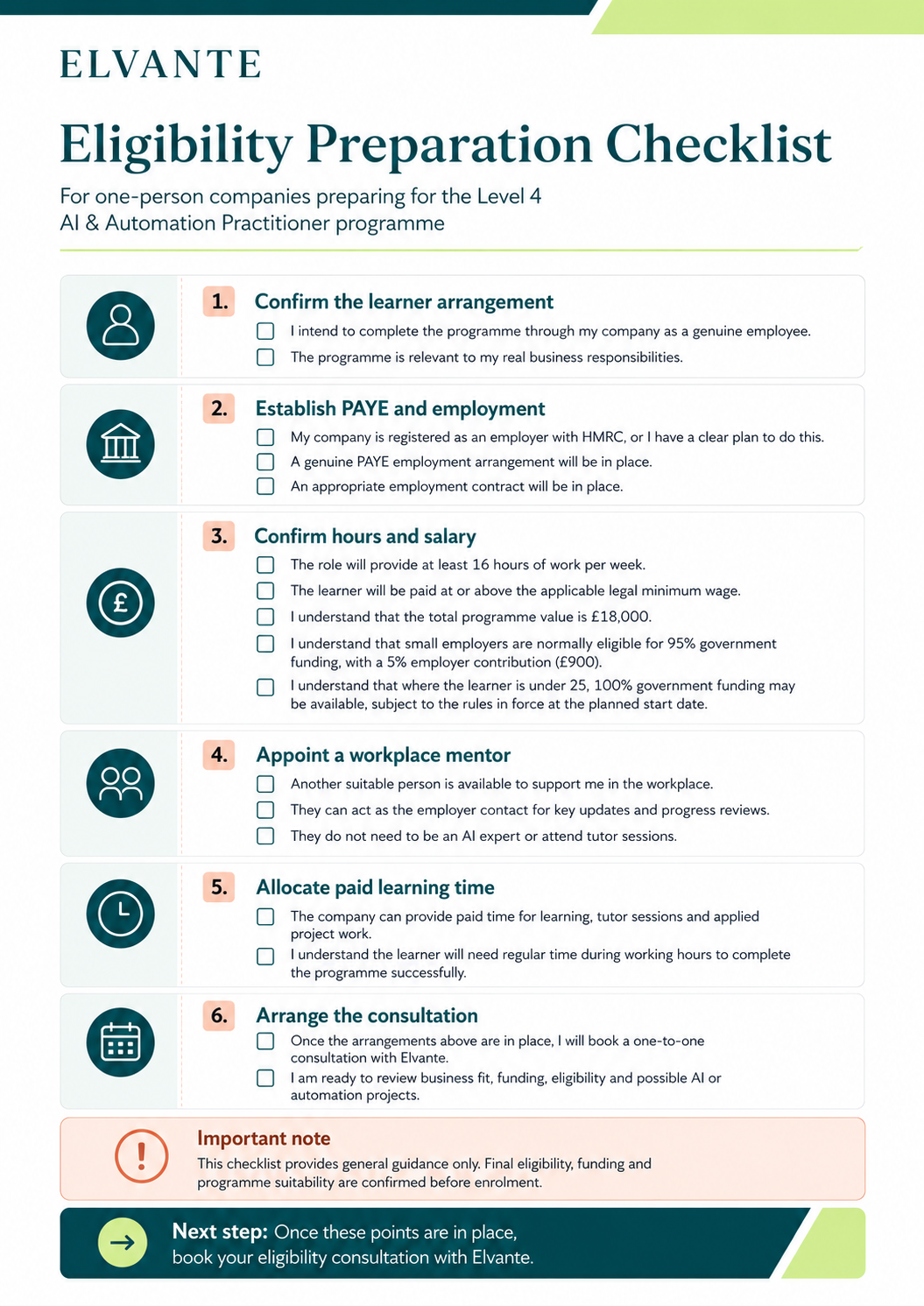
Confirm the learner arrangement
Confirm that you intend to complete the programme through the company as a genuine employee.
Establish PAYE
Register as an employer and put the employment and payroll arrangement in place.
Confirm hours and salary
Ensure the role provides at least the required hours and legal level of pay.
Appoint the mentor
Identify another suitable person who can genuinely support and review the learner.
Allocate paid learning time
Make sure the company can provide the required time for tutor sessions, learning and applied business projects.
Arrange the consultation
Once the arrangements are in place—or there is a realistic and specific plan—speak with Elvante so the full employer and learner eligibility can be reviewed.
Is becoming eligible worth the effort?
Establishing PAYE and a genuine workplace-support arrangement is a real business commitment. It should not be done solely to access a training programme.
However, where the arrangement makes sense for your company, the programme can provide approximately 12 months of individual business and technical support, help you build practical systems around your own operations, and lead to a recognised Level 4 qualification.
It may be worth exploring when:
- You genuinely want to formalise your role within the company.
- You plan to develop the business over the next 12 months.
- There are processes you want to automate.
- You can commit time to implementing improvements.
- A suitable mentor can provide genuine support.
It may not be appropriate when:
- PAYE would exist only temporarily or artificially.
- No genuine mentor is available.
- The company cannot provide paid learning time.
- The programme does not connect to real business responsibilities.
- The employment cost or administration is not commercially sensible.
A high-value programme with substantial government support
For small employers, 95% government funding is normally available towards the programme cost. The employer contributes the remaining 5%.
Total programme value
The government normally covers 95% of the cost. The employer contribution is 5%, which is £900 for this £18,000 programme.
Standard small-employer funding
Government funding: 95%. Employer contribution: 5% (£900).
Potential full funding
Where the learner is under 25, the employer may qualify for 100% government funding, subject to the funding rules in force at the planned start date.
Put the requirements in place, then let us review the opportunity with you
Once PAYE, the employment arrangement and a genuine mentor are in place—or you have a realistic plan with clear dates—we can arrange a one-to-one consultation.
During the consultation, we will review the business, the learner’s role, funding, eligibility, programme commitment and the types of AI and automation projects that could be developed.